Updated every Monday!   Subscribe to free weekly newsletter.

ID Vault: Million Dollar Protection Policy?

With so many phishing attacks and incidents of ID theft occurring, many consumers are leery of entering into any financial transactions online.

Where there is fear, however, there is also a business opportunity to allay those concerns. Enter ID Vault. It looks like a thumbdrive that you plug into an available USB port on your computer. It stores your usernames and encyrpted passwords, and automatically transmits them securely when you log into a financial or retail website. It can also determine if you are visiting a real site, or a scammer’s copy. Bottomline: it protects you.

They are so sure of their technology that they offer a “$1,000,000 Guarantee” that promises to cover your losses if your login credentials are stolen and used fraudulently. Quoting from their press release:

Consumers can now bank, shop and invest online with total confidence, knowing that even if their personal information were stolen while using ID Vault, GuardID will reimburse them for any losses up to $1 million.

“We are so confident that ID Vault 2008 will protect consumers from online identity theft and fraud, that we put our money where our mouth is, and will refund any losses consumers incur, up to one million dollars, when using ID Vault,” said Jerry Thompson, CEO of Guard ID Systems.

And on their website, here is the big print of their $1,000,000 Guarantee:

ID Vault guarantee

Of course the devil is in the details.

*MOUSE PRINT:  The company may have led you to believe you will have more coverage than they actually will provide (depending on the circumstances). They will only cover you up to $100,000 per account, not $1,000,000 as you might have expected.

“Should we determine that the account was exclusively accessed online using ID Vault prior to the theft of your account credentials, we will reimburse any direct loss, up to $100,000 per individual account and up to a maximum of $1,000,000 over the lifetime of your ID Vault subscription and subsequent renewals.”

In a sense, that is like buying a million dollar fire insurance policy, but only being able to collect $100,000 per fire. Granted, if you are lucky enough to have a millon dollars, and spread it out over 10 different accounts, then you would indeed be qualified to be reimbursed for $1,000,000.

The restrictions in the policy also require you to be 100% faithful to ID Vault as the means of logging into your accounts. You cannot access them on your work computer, or anywhere else, unless there is an ID Vault attached. (And they will compare your financial institution’s records of your accesses with the list of accesses tucked inside your ID Vault. If they don’t match exactly, you lose the coverage.) 

So, what may seem like a simple $1,000,000 guarantee promoted in advertising, is in fact full of strings and loopholes, as any other insurance policy would be.

Updated every Monday!   Subscribe to free weekly newsletter.

Verizon: When “Unlimited” Doesn’t Mean Unlimited

Verizon unlimited broadband No one wants to have to watch the clock or keep track of kilobytes downloaded when surfing the net while traveling, so when Verizon offered “unlimited” broadband access for your laptop via its cell towers, many consumers signed up.

From a 2005 press release announcing a promotion for its BroadbandAccess service, Verizon said:

Because of Verizon Wireless’ number of customers, network footprint and experience in deploying a national wireless broadband service, customers can take advantage of unlimited BroadbandAccess for $59.99 monthly access with a two-year customer agreement.

The problem was that “unlimited” did not really mean unlimited.

*MOUSE PRINT: The downloading of movies and playing online games were not allowed. And there was an undisclosed cap on monthly usage which could trigger termination of your account. The service was primarily intended for web browsing, email and intranet access only.

Unfortunately for Verizon (and fortunately for consumers), the New York Attorney General started investigating the promotion, and learned that some 13,000 customers nationwide had had their services terminated for excessive use of the unlimited service they purchased.

To settle the case, Verizon agreed to reimburse terminated consumers some $1 million in costs for their equipment, and pay $150,000 to the NY-AG. [Settlement announcement from the New York Attorney General.]

Currently, on the Verizon Wireless website, the service is being marketed specifically for web browsing, email and intranet access, and all references to unlimited use have been removed:

verizon broadband updated

Their terms and conditions now explicitly state what activities are prohibited and what the cap is on usage.

For its part, Verizon said:

“We are pleased to have cooperated with the New York Attorney General and to have voluntarily reached this agreement,” said Howard Waterman, a spokesman for Verizon Wireless. “When this was brought to our attention, we understood that advertising for our NationalAccess and BroadbandAccess services could provide more clarity.”

Putting aside the PR BS, let’s hope this is a lesson not only to Verizon about how it promotes its services, but also to other providers who also promise “unlimited” service but in fact have undisclosed usage caps.

[Disclosure: Edgar is a new member of Verizon’s Consumer Advisory Board and receives a small grant to help operate ConsumerWorld.org .]

Updated every Monday!   Subscribe to free weekly newsletter.

Laplink PCMover: Use Once, Throw Away?

pcmover small Getting a new computer is always a hassle because of the difficulty of transferring your programs and files from the old computer to the new one.

To make the task easier, some programs are for sale that do the heavy lifting for you. You install it on both the old and new computers, connect them together, and woosh… most programs, files and setting get moved over automatically.

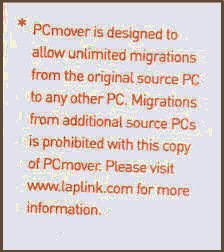
There is just one problem. Not likely noticed by most purchasers of Laplink PCmover, is the little asterisk on the product’s cover to the right of the words “Move All Your Programs, Files and Settings to a New PC*”. That leads to a fine print disclaimer on the side of the box that says:

*MOUSE PRINT:

disclaimer

Translation: The product is in essence for one time use only. Even if you uninstall it from your old computer, you cannot reinstall it on another old computer you want to migrate without violating terms of the licensing agreement. For that, you have to buy an additional license (albeit at a 25% discount).

At a list price of $59.95, you should be able to use the program at home one set of computers at a time as you probably expected you could.

Â