Updated every Monday!   Subscribe to free weekly newsletter.

Microban 24: Kills Viruses and Bacteria for 24 Hours?

Everyone is very conscious these days of keeping surfaces that we touch as sanitary as possible. So what a perfect time to promote this product, Microban 24, that kills viruses and bacteria.

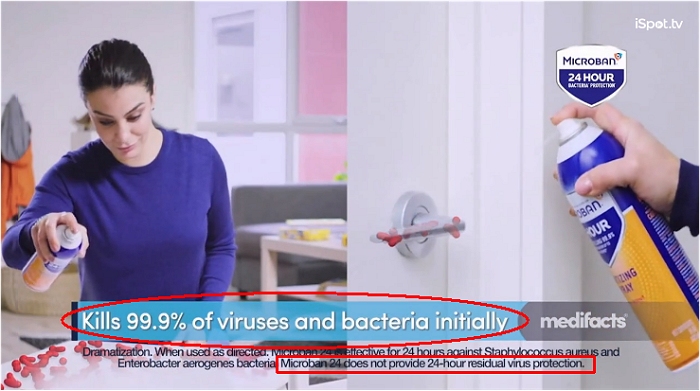
What is the impression you come away with after watching that commercial? They claim that Microban 24 kills 99.9% of viruses and bacteria, and you may believe they said it works for 24 hours. Watch the commercial again.

*MOUSE PRINT:

Microban fine print

They actually claim, combining their oral statements and fine print disclaimer that Microban 24 kills bacteria for 24 hours, but only kills viruses initially (upon spraying) and NOT for 24 hours. The company cleverly omits the word “viruses” when making its 24-hour claim.

So despite the product’s name, and a very carefully worded commercial where every word is literally true, a consumer could very easily come away with an incorrect impression of the efficacy of the product. And under FTC theory of the law, this could make the ad deceptive.

It is the net impression conveyed by a solicitation, “not its literal truth or falsity,” that determines whether it is deceptive. FTC v. Cyberspace.com, LLC, 453 F.3d 1196, 1200, 1201 (9 Cir. 2000).

We asked Procter & Gamble, the maker of the product, why they don’t clearly state orally that virus protection does not last 24 hours, and whether they would consider modifying their advertisements to more clearly disclose the limited nature of the virus protection. P&G did not respond to our inquiry.

UPDATE October 28: The EPA just granted approval to add Microban 24 to its list of products that can kill the coronavirus within 60 seconds. But, that does not change the fact that P&G’s product does not continue to kill viruses for 24 hours contrary to the impression created by their advertising.

Updated every Monday!   Subscribe to free weekly newsletter.

Walgreens Shortchanges Customers on Some Coupons

MrConsumer became a victim of a sneaky practice by Walgreens a few weeks ago. He spotted a great deal on Crest 3D White toothpaste, and even promoted it to readers as a “Bargain of the Week” in Consumer World.

Walgreens Crest offer

In this offer, if you bought four tubes of Crest, one of them would be free, plus there was an additional $1 electronic coupon and also an $8 one. Conceivably you could snare all four tubes for only $1.77. It was unclear if one of these coupons was a store coupon and one a manufacturers coupon, so I e-clipped both. I thought if the $1 coupon could not be used in combination with the $8 coupon, obviously I would just use the $8 one.

At the store, the cashier scanned my loyalty card and the four tubes. The total on the screen said $9.77 (before tax) rather than the $1.77 or $2.77 that I expected. This happened because it only took off the $1 coupon. I told her something was wrong because I had also e-clipped an $8 coupon. What she said next floored me.

*MOUSE PRINT:

“The system only takes off the LOWEST value coupon.”

Say what? She said that she could not manually remove the $1 coupon, that I would have to do it in my e-wallet, and then the system would accept the $8 one. I showed the cashier that I didn’t see any apparent way to remove a coupon at the Walgreens website on my cellphone. She said that can only be done in the Walgreens app, which I did not have.

So I left the four tubes at the checkout and headed home to install the Walgreens app and try to remove the $1 coupon. That part of this saga was successful, so I drove back to the store. A different cashier found my four tubes of Crest behind the counter and rang up the order. This time the system took off the $8 coupon properly, which I pointed out to the cashier. She too reiterated that Walgreens’ checkouts only deduct the lowest value coupon applicable to the order.

I couldn’t believe that any company would deliberately create a system to deny customers the use of a legitimate high-value coupon that was properly clipped particularly since the company was getting reimbursed in full for it by the manufacturer.

So we asked Walgreens why they had such an anti-consumer policy. A PR spokesperson for the company replied:

“Thanks for bringing this to our attention. Our current POS [point-of-sale] system is not able to logically determine the best offer at the customer transaction level. Our system applies digital coupons based on the order that the customer activated them along with corresponding expiration dates. We are working with our CPG partners as well as our digital coupon provider to develop remedies outside of our POS. In addition, we are developing a capability for our team members at POS to be able to add and remove coupons at the time of checkout on behalf of the customer. We will follow-up with you as we have more information to share.”

A number of shoppers have posted complaints online including saying that the Walgreens policy noted just above was changed toward the end of 2019 to a lowest value first one.

While we are pleased to have prompted Walgreens to work on a variety of solutions, this never should have happened. A simple highest value first policy would benefit shoppers the most, just like the one used by supermarket chain Hy-Vee:

*MOUSE PRINT:

“If more than one digital coupon is loaded for the same product, the best value will be redeemed at checkout.”

Updated every Monday!   Subscribe to free weekly newsletter.

Black Forest Products: Real Juicy?

MrConsumer saw this commercial for a new product under the brand name Black Forest last week:

It certainly conveys a warm, woodsy, natural feeling to viewers. And the products seem like they are healthy because the announcer says they are “made from real fruit juice and colors from natural sources… Black Forest — real juicy, real good.”

What caught MrConsumer’s eye, however, was the faint footnote:

*MOUSE PRINT:

footnote

Say what? Only 7.9 percent juice? What’s the rest of it? You guessed it — primarily sugar.

*MOUSE PRINT:

Nutrition facts

While apple juice concentrate is the third ingredient, the other fruits pictured on the “Juicy Burst” box are the last three ingredients. In fact, there is more wax in the product than those juices. And a number of other fruits and vegetables are only used as coloring. The nutritional value of this juicy fruit snack is pretty much limited to the vitamin C that the company adds.

So while this product is portrayed as a seemingly healthy snack, we’d call it candy. And no wonder, the Black Forest brand is owned by the Ferrara Candy Company which makes Brach’s, Nerds, SweeTarts, Chuckles, RedHots, and classic candy corn.