Updated every Monday!   Subscribe to free weekly newsletter.

This is a Weight Loss Pill, Right?

Last year, a consumer purchased a bottle of Garcinia Cambogia Extract from a Vitamin Shoppe location in California believing that this product could help her lose weight.

Vtiamin Shoppe

*MOUSE PRINT:

In much smaller print, the bottle was labeled “weight management” and “appetite control” leading her to believe this was just the type of product she was looking for. (The caret after those terms merely refers to the standard fine print disclosure on the back of the label that the FDA has not evaluated these claims.)

Apparently she did a little research after purchasing it and found a study or studies from which she concluded that this stuff had been “scientifically proven to be incapable of providing such weight-loss benefits.” So like any good consumer, rather than going back to the store to get a refund, she filed a class action lawsuit alleging misrepresentation and false advertising, among other claims.

To her surprise, the judge ruled against her, saying in his decision:

The first problem with Plaintiff’s complaint is her assertion that the phrases “Weight Management” and “Appetite Control” equate to representations that the Product provides weight-loss benefits. “Weight Management” suggests management or control of one’s weight, whose upward or downward departure may differ depending on an individual person’s goals, i.e., to gain, lose, or maintain one’s weight. “Appetite Control” indicates control of one’s appetite, which may or may not ultimately result in weight-loss. Thus, it is irrelevant whether the alleged studies disprove that the active ingredients in the Product can produce weight-loss benefits because the phrases themselves do not inherently promise weight-loss benefits.

Say what? If putting the terms “weight management” and “appetite control” on a pill bottle doesn’t suggest that the contents are good for losing weight, what do they suggest?

Updated every Monday!   Subscribe to free weekly newsletter.

Is This Stuff Really “Ice Cream?”

A new brand of “ice cream” called “Enlightened” has hit the market claiming only 60 – 100 calories per serving, with “more protein and less sugar.”

They picture 27 varieties of pints of ice cream in fancy flavors like this on their website:

Enlightened 4 pints

Each of the descriptions under those containers, and even the containers themselves call the product “ice cream.” And on individual product pages, the manufacturer repeatedly refers to the product simply as “ice cream.”

Red Velvet on web

Under federal law, a “standard of identity” defines when you can label a product as “ice cream”:

“Ice cream” is a frozen food made from a mixture of dairy products, containing at least 10 percent milkfat. It also cannot be aerated (“overrun”) by more than 100%. And a gallon must weigh at least 4.5 pounds. [language simplified]

Their nutrition label on the red velvet “ice cream” flavor, for example, reveals a fat content of only 2 grams in a 70 gram (half cup) serving:

nutrition label

So clearly, there is not at least 10% milkfat in this product, and therefore legally it cannot be simply labeled “ice cream.”

You can’t tell looking at the pictures of the pint containers on the website, but a visit to a grocer’s freezer case reveals a secret on the package.

*MOUSE PRINT:

fine print

At the very bottom of the container in the tiniest print, which many people might miss, it says “low fat ice cream.” And that is completely different from plain old “ice cream.”

Federal law requires conspicuous disclosure of the legal name of the product, the statement of identity:

…be presented in bold type on the principal display panel, shall be in a size reasonably related to the most prominent printed matter on such panel, and shall be in lines generally parallel to the base on which the package rests as it is designed to be displayed. 21 CFR 101.3

And under separate FDA rules, products can be labeled as lower in fat if they meet these requirements:

  • “Reduced fat” ice cream contains at least 25 percent less total fat than the referenced product (either an average of leading brands, or the company’s own brand).

  • “Light” or “lite” ice cream contains at least 50 percent less total fat or 33 percent fewer calories than the referenced product (the average of leading regional or national brands).

  • “Lowfat” ice cream contains a maximum of 3 grams of total fat per serving (½ cup).

  • “Nonfat” ice cream contains less than 0.5 grams of total fat per serving.

  • Because this flavor of Enlightened has less than three grams of fat per serving, it can and must be labeled as “low fat ice cream” and not merely “ice cream.”

    We asked Enlightened how the company could refer to these products merely as “ice cream” under the standard of identity and it referred us to the above chart.

    Is the fine print disclosure they make on the container sufficient disclosure to purchasers? Are repeated references merely to “ice cream” in marketing materials and on the package misleading? We filed a complaint with the FDA asking them to look at this case, and we’ll report their findings (if any).

    We’re not alone in raising questions about these newfangled “ice creams.” A class action lawsuit was filed last month against Halo Top, the most famous of these new lower calorie brands, making similar allegations as we have about Enlightened. (Hat tip to TruthinAdvertising.org for this lawsuit.)

    Updated every Monday!   Subscribe to free weekly newsletter.

    Here We Downsize Again (2018) – Part 1

    In the never ending saga of products shrinking in size as a means to pass on a sneaky price increase to consumers, we offer these three new ones thanks to our eagle-eyed readers.

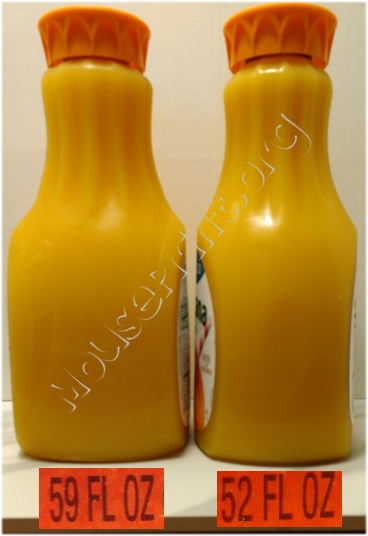
    John R. spotted this gem in the dairy case. As he points out, orange juice makers laid the groundwork for being a commonly downsized item when most brands discontinued half gallon containers in favor of 59 ounce ones. And now at least one big brand is at it again.

    *MOUSE PRINT:

    Simply Orange

    Simply Orange has just gone from 59 ounces down to 52 ounces. On its website, the company explains their decision:

    The decision to reduce our 59-ounce PET package was made after careful consideration of the current cost pressures within our supply chain as well as clear data on consumer’s price preferences. We are committed to bringing quality juices and drinks to the market and have decided to reduce our 59-ounce PET package in order to keep prices fair for our loyal customers. As part of our ongoing commitment to keep shoppers well informed, we are communicating the new 52-ounce PET package size on the Simply website and we are making the package weight more prominent on our front-of-pack labeling.


    The ever-shrinking toilet paper roll is getting smaller again, at least for purchasers of Quilted Northern. Our ace downsizing detective, Richard G., found the latest example.

    *MOUSE PRINT:

    Quilted Northern

    The “mega” roll has gone from 330 sheets to 308 sheets.


    Lastly, TRESemme shampoo has downsized at least one of its varieties again.

    *MOUSE PRINT:

    Tresemme

    TRESemme

    Most varieties of TRESemme were 32 ounces originally. Then they were downsized to 25 to 28 ounces depending on the type. Now a “new look” bottle signals yet another change — this time it is down to just 22 ounces for one variety.

    Thanks to Richard G. for finding this latest change. If you spot a product that has shrunk in size, try to send a sharp picture of both the old and new package to Mouse Print*.