Ever on the hunt for a good deal to promote as Consumer World’s “bargain of the week,” MrConsumer electronically thumbed through the Lowe’s Labor Day sale circular late last week. He found a sale on Bosch dishwashers, which usually have very good product reviews from shoppers, and tend to be rated very highly by Consumer Reports. Making the deal even better — almost unbelievable — was the fact that Lowe’s was advertising free installation via a rebate.
Here is part of their Labor Day print circular featuring five Bosch dishwashers as low as $449. And the free installation rebate is smack in the middle of all these models. All the asterisks and other symbols just below the green arrow concerning the rebate shed no light on the actual restrictions.
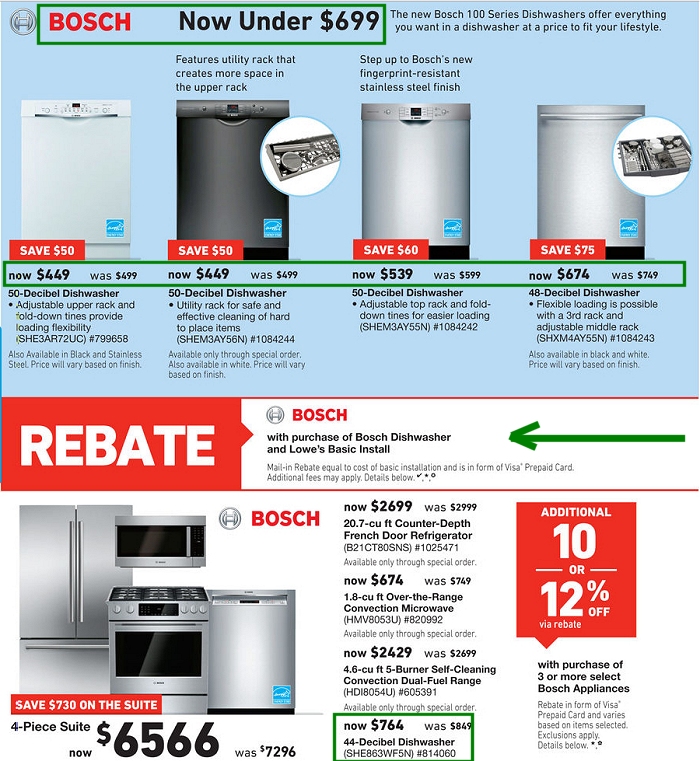
Taking a closer look at one of the cheapest Bosch models at $449, the Bosch SHE3AR72UC, which grabbed Consumer Reports’ highest rating of any dishwasher (though only lukewarm reviews by Consumer Reports readers), the Lowe’s website provided the following product listing, and noted the availability of two rebates on this model.

When clicking to get the details of the installation rebate, the shopper is presented with a surprising catch:
*MOUSE PRINT:
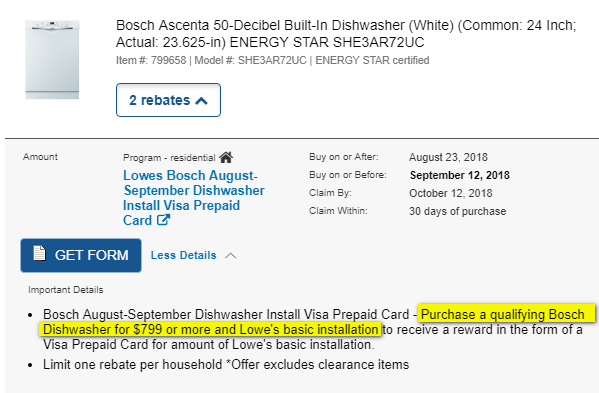
It said that the rebate only applies to Bosch dishwashers $799 or higher! But the rebate form doesn’t say that. The newspaper circular doesn’t say that. And the big print description of the rebate on the website doesn’t say that.
So we wrote to the PR folks at Lowe’s to ask which was correct: that the rebate offer only applied to dishwasher models $799 or higher, or that it applied to all models listed in the circular, shown on the website, and listed on the rebate form.
Less than 24 hours later, an inconspicuous change was made to the website — they removed the $799 minimum purchase language!
*MOUSE PRINT:

A Lowe’s spokesperson confirmed to Mouse Print* that the promotion in question did not have a minimum purchase threshold and all references to it were removed from their website. The company said that the $799 minimum purchase requirement was never intended to apply to this sale.
Incidentally, in the Boston area, Lowe’s charges $239 for installation. So getting that free is seemingly quite a savings. But, before you run to Lowe’s to buy a Bosch dishwasher because of this great deal, understand that Lowe’s plays by the book in terms of obtaining a local plumbing permit if required by your city or town. In my town, for example, Lowe’s will add a charge of $170 for the permit!!! Since this seemed rather high, MrConsumer contacted the city’s inspectional services department and found out that the actual cost is only $60. Lowe’s is charging an additional $110 for the time it takes a third party contractor to wait in line at city hall, it appears. And Lowe’s says that homeowners CANNOT get the permit on their own to save money. The Lowe’s spokesperson could not get a formal response by publication time as to why the company has such an anti-consumer policy.
In addition, Lowe’s, like other appliance sellers, does not include in the advertised price of the dishwasher the drain pipe, necessary adapters, and the electrical cord. That’s another $50. And haul away is yet $20 more.
So, what started as a great bargain is turning out to be a very expensive proposition unless you do the installation yourself.


